
Homeopathy For Acne
Why Your Acne Keeps Coming Back — And Why It’s Rarely Just About Your Skin
Acne now affects roughly one in five adults between 25 and 39, and global cases have climbed sharply since 1990. It’s no longer “just a teenage phase.” For a growing number of adults — especially women — breakouts are showing up for the first time in their late twenties, thirties, and forties, often for reasons that have nothing to do with skincare routine.
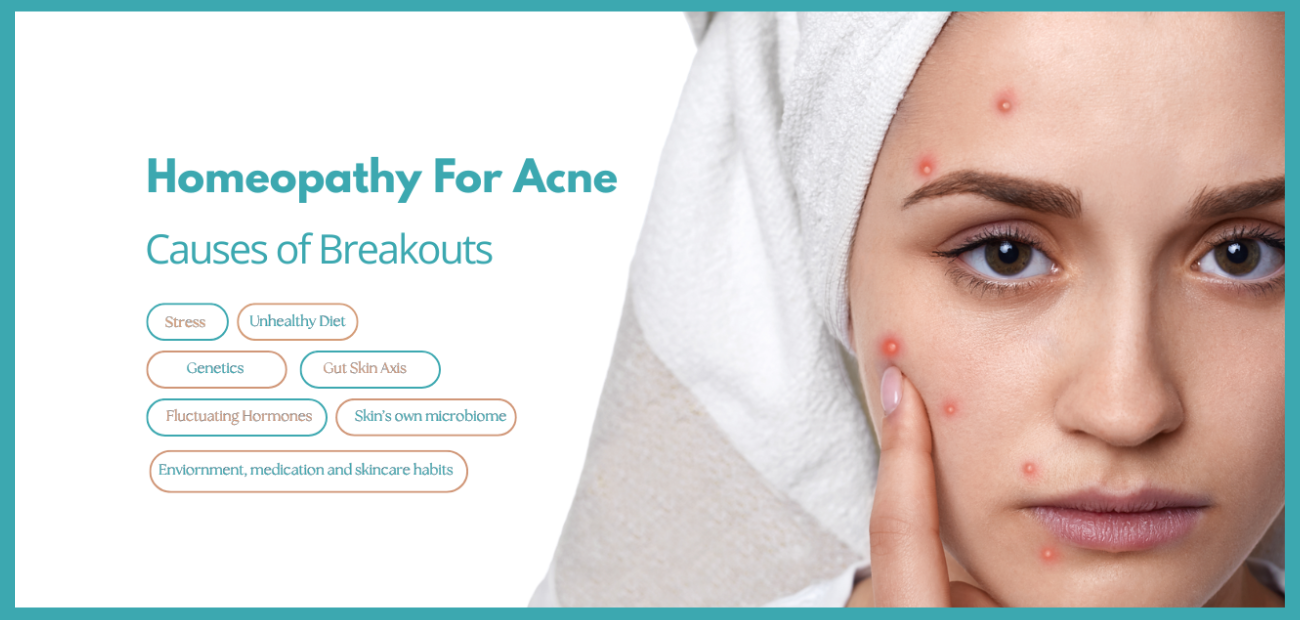
If you’ve cleansed, exfoliated, and medicated your skin from the outside without lasting change, the reason may be simple: acne is rarely caused by one thing. Dermatology research increasingly describes it as the result of several systems interacting at once — genetics, hormones, gut health, the skin’s own microbiome, stress physiology, diet, and even the environment around you. Treating only the surface, while ignoring which of these is actually driving your case, is a major reason acne relapses the moment treatment stops.
This piece walks through what current research says is actually behind adult acne, then explains why an individualised, whole-person approach like homeopathy is built specifically to address that complexity — rather than fight the same visible symptom in everyone the same way.
Acne Is a “Multifactorial” Disease — Here’s What That Actually Means
Clinically, acne forms through four connected processes: excess oil production, changes in oil composition, clogged pores from a buildup of dead skin cells, and inflammation driven by bacteria. In teenagers, the hormonal surge of puberty sets all four in motion together. In adults, the same four processes are still at work — they’re just triggered by different, more individual factors, and they tend to cluster in different places on the face (jawline, chin, and neck, rather than the T-zone).
Research groups now describe genetic predisposition, hormones, the gut and skin microbiome, psychological stress, air pollutants, aggressive facial products, and certain medications as the recognised drivers of acne formation — with diet’s role still debated but increasingly hard to ignore.
Here’s a closer look at each.
1. Genetics and Family History
A 2025 systematic review of adult female acne highlighted that a positive family history is one of the more consistently linked factors in adult-onset cases — alongside hyperandrogenism and a high-glycemic diet. If a parent or sibling had persistent adult acne, your skin may simply run a lower threshold before oil glands over-react to the same hormonal or dietary triggers that other people tolerate fine.
2. Hormones — Especially If Your Acne Sits Along the Jawline
Hormones remain one of the most well-documented drivers of adult acne. Two mechanisms stand out:
- Hyperandrogenism — elevated androgens (present in everyone, in different amounts) directly increase oil gland activity and follicular blockage, the two building blocks of acne.
- Insulin resistance and IGF-1 — oil glands respond directly to growth signals from insulin and insulin-like growth factor 1 (IGF-1), tying hormonal acne directly to metabolic health and diet. A large study of women with PCOS found that markers of insulin resistance and elevated DHEAS (an androgen) were strongly correlated with both the presence and severity of acne.
This pattern is particularly relevant if your acne:
- Sits mainly along the jawline, chin, or lower face
- Flares predictably in the week before your period, as progesterone rises and estrogen drops
- Comes with irregular cycles, excess hair growth, or difficulty losing weight
- Hasn’t responded well to topical treatment alone
These patterns often point toward PCOS or a broader hormonal-metabolic imbalance rather than a purely topical skin issue. Conventional medicine typically manages this with hormonal contraceptives, anti-androgens, or insulin-sensitising drugs like metformin — genuinely effective for many people, but not something everyone wants to be on indefinitely, and not something that necessarily addresses why the imbalance developed in the first place.
3. The Gut-Skin-Brain Axis
A growing body of research describes a bidirectional communication network — the gut-skin-brain axis — linking digestive health, the nervous system, and skin inflammation. The gut microbiome helps regulate immune response, nutrient absorption, and systemic inflammation; when it’s disrupted (dysbiosis), that disruption is increasingly linked to inflammatory skin conditions, acne included. A 2023 study went further, correlating gut microbiota composition and circulating hormone levels directly with acne lesion counts and skin biophysical features — suggesting the gut and hormonal pathways aren’t separate systems, but frequently feed into each other.
4. The Skin’s Own Microbiome — and Your Emotional State
It isn’t only the gut microbiome that matters — the skin has its own resident microbial community, and disrupting it (through over-washing, occlusive masks, or harsh products) is associated with more breakouts. A 2025 study published in Frontiers in Cellular and Infection Microbiology found that negative emotional states were associated with measurable alterations in the facial skin microbiome in people with acne — direct evidence for what’s been called the “brain-skin connection”: stress doesn’t just make skin feel worse, it appears to physically reshape the bacterial ecosystem living on it.
5. Stress Physiology
Stress affects skin through more than mood. Sustained stress triggers cortisol production via the brain-adrenal axis — but skin cells themselves run a miniature version of that same stress-response system, producing their own stress hormones that bind directly to receptors on oil glands and ramp up sebum production. This is why breakouts so often spike during exam season, work deadlines, or emotional upheaval, independent of anything applied to the skin.
6. Diet
High-glycemic-index foods (sugar, refined carbohydrates) and dairy have both been associated with increased acne severity across multiple studies, most likely because they raise insulin and IGF-1 — the same hormonal pathway implicated in the gut-skin axis. This doesn’t mean every food trigger applies to every person; it’s a pattern worth reviewing with a practitioner rather than guessing at alone.
7. Environment, Medications, and Skincare Habits
Airborne pollutants — particulate matter from traffic, industrial emissions, and smoke — can settle on skin and contribute to clogged pores and oxidative stress. Certain medications, notably steroids and lithium, are recognised triggers. And everyday skincare habits can quietly work against you: over-washing strips protective oils and triggers rebound oil production, while heat, humidity, and mechanical friction (mask-wearing is a well-documented recent example) disrupt the facial microbiome and worsen breakouts.
Why the Middle East and South Asia Are Seeing More Adult Acne
Global epidemiology data shows acne prevalence is notably higher in the Middle East and parts of Asia compared to North America and Europe — a pattern researchers link partly to diet, humidity, and lifestyle stress. For patients in Bahrain and India, this makes the combination of gut, hormonal, environmental, and stress factors especially relevant, rather than incidental.
Bahrain-Specific Triggers Worth Knowing
If you live in Bahrain, a few local factors make this combination of causes even more relevant to your skin:
- Heat and humidity — Bahrain’s climate keeps skin warm and sweating for much of the year, which increases oil production and creates the exact conditions that clog pores and disrupt the skin’s microbiome.
- Diet patterns — a diet that leans on refined carbohydrates, sugary drinks, and dairy — common in the region — feeds the same insulin/IGF-1 pathway linked to hormonal acne.
- High rates of PCOS and insulin resistance — PCOS and metabolic conditions are widely reported across the GCC, making jawline and hormonal acne a particularly common presentation among women in Bahrain.
- Indoor air-conditioning swings — moving constantly between humid outdoor air and dry, cooled indoor air stresses the skin barrier, often worsening breakouts that don’t respond to standard creams.
- Fasting and routine changes during Ramadan — shifts in eating times, hydration, and sleep can temporarily disrupt gut and hormonal patterns and are a common trigger for flare-ups reported by patients.
If any of this sounds familiar, it’s a strong sign that your acne is being driven by more than what’s on the surface — and that a case history built around your actual lifestyle in Bahrain, not a generic routine, is the right starting point.
Why This Changes How Acne Should Be Treated
Given how many independent systems can be behind the same-looking breakout, it makes sense that two people following an identical skincare routine get completely different results. The actual driver in one case might be gut-related inflammation; in another, a hormonal-metabolic pattern; in a third, stress physiology and a disrupted skin microbiome. Applying the same cream to all three was never going to work equally well for everyone.
Where Homeopathy Fits — and Why Its Approach Suits a Multifactorial Condition
This is precisely the kind of complexity homeopathy is designed to work with. Rather than starting from “acne” as a single diagnosis and reaching for a standard remedy, a homeopathic consultation is built around constructing a complete picture of the individual, aiming to identify which of the pathways above — hormonal, digestive, stress-driven, or a combination — is actually behind that person’s presentation.
| What’s assessed | Why it matters for acne |
| Digestive pattern (bloating, constipation, food reactions) | Reflects gut-skin axis activity |
| Hormonal history (cycle, PCOS, thyroid) | Androgens and insulin resistance directly drive sebum production |
| Stress response and sleep | Cortisol and gut-brain-skin signalling can worsen flare-ups |
| Family history | A recognised factor in adult-onset acne |
| Type, location, and triggers of breakouts | Helps distinguish hormonal, bacterial, and inflammatory patterns |
| Skin’s individual reactivity | Informs which constitutional remedy may fit |
From there, a remedy is selected to match that individual pattern, rather than a single “acne remedy” applied to everyone. Remedies such as Hepar Sulphuris, Kali Bromatum, and Silicea are classically associated with different acne presentations in homeopathic literature — but which one, if any, is appropriate depends entirely on the individual case history. This is exactly why self-treating from a list rarely works as well as a proper consultation, and why case-taking in acne tends to be more involved than in almost any other skin condition.
Why people look to this approach specifically for acne:
- It’s built around the whole person, not the breakout. Because the same visible symptom can come from different underlying patterns, an approach that starts with a detailed case history — cycle, digestion, stress, sleep, family history — is structurally suited to a condition where the same treatment genuinely doesn’t work for everyone.
- It doesn’t rely on suppressing the skin’s response. Homeopathic treatment is gradual by design, aiming at the underlying pattern rather than the surface symptom. Patients are typically advised to expect visible change over several weeks, with other things often improving alongside the skin — more regular digestion, better sleep, fewer stress-related flares.
Frequently Asked Questions
Is homeopathy effective for hormonal acne? Hormonal acne — jawline breakouts, cycle-linked flare-ups, PCOS-related acne — is one of the areas where addressing the root hormonal pattern, rather than just treating the skin, tends to matter most. This is a core part of the homeopathic approach, though individual results vary and it’s worth discussing your specific case with a practitioner.
Could my acne be a sign of PCOS? Jawline-predominant acne combined with irregular cycles, excess hair growth, or weight changes is worth discussing with a doctor, since this pattern is commonly associated with hormonal and metabolic imbalances such as PCOS, which benefits from proper diagnosis.
How long does homeopathic acne treatment take to show results? This varies by individual, but because the goal is addressing an underlying pattern rather than suppressing a symptom, most patients are advised to allow several weeks before expecting visible change.
Can homeopathy be combined with a dermatologist’s treatment? This is best discussed directly with both practitioners, as it depends on your specific treatment plan, the severity of your acne, and your skin history.
The Bottom Line
If your acne keeps returning no matter what you put on your skin, current research increasingly points away from the surface and toward what’s happening underneath it — genetics, hormones, gut health, stress physiology, and the skin’s own microbiome, often acting together rather than in isolation. Identifying which of these is driving your specific case, rather than applying a generic routine, is where a proper homeopathic consultation — alongside conventional medical input where needed — tends to start.
Ready to Get to the Root of Your Acne?
If you’re in Bahrain and tired of breakouts that keep returning no matter what you try, a detailed case history can help identify whether your acne is being driven by hormones, gut health, stress, or a combination — and what to actually do about it.
Book a one-on-one consultation today to map your cycle, digestion, stress patterns, and skin history against a treatment plan built for you, not a generic routine.
WhatsApp us to schedule your appointment
This article is for general information and does not replace individual medical advice. If you have symptoms suggesting PCOS, a hormonal condition, or moderate-to-severe acne, please consult a doctor or dermatologist.